Small business guide to generative AI
Unless you’ve been stranded on a desert island since November 2022 (when ChatGPT was launched) you’ve probably heard of generative AI (GenAI). Since then, GenAI has transformed how businesses operate. However, you may not fully understand what generative AI is or the opportunities it brings to small businesses.
In today’s rapidly evolving digital landscape, it is essential for business owners to understand the capabilities of GenAI if they are to remain competitive. Generative AI creates new content rather than just analysing existing data – like having a creative assistant that never sleeps.
This creative ability is what has made GenAI a game changer for consumers and businesses alike.
GenAI benefits for small business
Now that we understand the basic premise of GenAI, we can dig into some of the key generic benefits it brings to small businesses.
Driving sales
In the same way the internet opened the world for smaller businesses to trade competitively, GenAI offers similar benefits. The vast array of new AI powered tools that appear almost daily illustrate the opportunities for businesses to spot a niche requirement that can be fulfilled by AI powered solutions. Organisations are monetising AI by developing new business models and products or services that address industry-specific challenges.
GenAI also opens the door to quickly analyse customer data and create personalised content at scale. What used to be an extremely time-intensive process can be easily handled with AI. The ability to be create personalised customer communications is now accessible for businesses of all sizes.

Boosting productivity whilst cutting costs
Using GenAI in business processes can help support the teams that already exist and fill the gaps where more staff aren’t available.
The 2025 Work Trends Index by Microsoft found that 53% of business leaders want to increase productivity and plan to upskill their workforce (47%) and expand team capacity with digital labour (45%). This will be achieved with AI agents or AI tools.
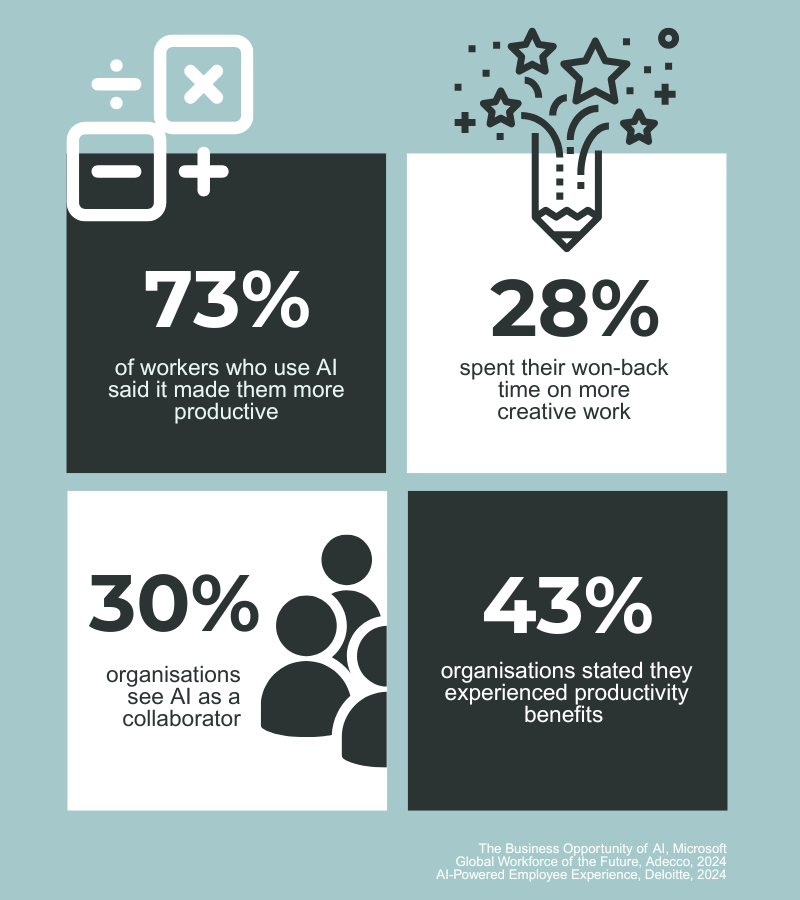
Studies show that employees are often more ready to use AI than business leaders. Those regularly using AI already recognise the value it brings to their work, especially because it can improve creativity and productivity. They want to improve their skills and are looking to their employers to invest in training.
In addition, there are a multitude of industry specific AI tools available that assist teams across various business functions. In the marketing industry alone 68% of marketers find AI automation of routine tasks helpful and nearly half surveyed said it improved the customer experience.
However, with the choice of AI tools now available the challenge now is finding the right tool and investing the time to evaluate whether it meets your objectives.
Delivering better customer experiences
Customer service has become an extremely popular area for GenAI adoption. The latest evolution – AI Agents – goes beyond simple chatbots to handle complex, multi-step customer interactions autonomously.
Unlike basic chatbots that follow pre-written scripts, AI Agents can reason through problems, access multiple systems, and complete entire workflows without human intervention.
Think of them as digital employees that work 24/7.
By 2029, Gartner predicts 80% of customer service issues will be resolved without human intervention – making AI Agents the primary support channel for forward-thinking businesses.

How to start using AI in your small business
If you’re a business owner, professional, entrepreneur and your interest has been piqued by the constant social chatter about GenAI, where should you start?
Experiment
If you’re new to GenAI we’d recommend experimenting with one of the four LLM (large language models): ChatGPT – OpenAI, Claude – Anthropic, CoPilot – Microsoft and Gemini – Google. These tools are the most well-known and offer free account options for those wishing to test the AI waters.
However, a word of caution to anyone using free accounts. Uploading personal, sensitive or confidential data into these could land you in a world of trouble. If you’re serious about using LLMs for work, invest in paid subscriptions that offer proper security like ChatGPT Teams. You’re looking for services that have SOC2 or ISO27001 accreditation.
Getting some hands-on experience with these tools is a great starting point. With a grasp of its capabilities, you’ll start recognising how it can improve your own workflows and build confidence towards taking the step towards implementation.
Practice prompting
One of the most important skills to learn is how to create effective prompts. Conversational chatbots like ChatGPT need instructions, known as prompts, to tell them what to generate. Just think of it being the same process as briefing a human member of your team. The more detail you give them the better their output will be.
There’s value in investing time perfecting your prompting technique. The goal is to avoid generic outputs. Once you’ve spent time interacting with the various LLMs, you’ll easily spot AI generated content.
By including detail around context (what you are looking to achieve and why), character (how you want the tool to behave) and include information specific to your situation, you’ll achieve a consistent level of high-quality output in a much shorter time frame.

Identify business challenges and bottlenecks
Now things are becoming a lot clearer, aren’t they? With more of an idea about what you can accomplish with GenAI (at Moremicro we use the adage “the only limit is your imagination”), you can identify areas in your business that could be potential avenues for use.
Breaking job roles into underlying sets of tasks is an effective way to identify opportunities.
The most important question still needs answering: “Is your organisation ready for AI?”
- Is your data digital and accessible? Paper-based systems and outdated storage will limit your AI options significantly.
- Do you have the technical expertise in-house? Most SMEs need external specialists to implement AI successfully.
- Are your current systems secure and compliant? AI amplifies both opportunities and risks, so solid foundations are essential.
- Is your team open to change? The best AI tools fail without user adoption and proper training.
If you’ve answered ‘no’ to more than two questions, don’t worry. Many SMEs start their AI journey by addressing these fundamentals first.
Develop your AI policy
The widespread use of AI means we’re confident when we say that AI is already in your business; whether you’re aware of it or not.
Even if you’re not ready to fully embrace AI within your organisation, you will need a clear AI usage policy. The last thing you want are employees risking data leaks or compliance breaches when they continue using their personal ChatGPT accounts.
Consider providing guidance around:
- Approved AI tools
- Acceptable use
- Output verification
- Error checking.
It’s also important to highlight the speed at which GenAI has been embedded into software that people have used for years, from web searches and graphic design applications to CRM systems and cyber security software. You may find your organisation is already inadvertently using AI.

Organisations that choose a blanket ban on employee use of AI risk losing competitive advantage to competitors who adopt AI responsibly. The effectiveness of such a ban can be called into question as frustrated employees chose to access them over personal devices, subsequently leading to serious concerns around data privacy and security.
Developing a clear AI policy enables your organisation to maximise the benefits of AI’s ability to drive sales, efficiency and innovation whilst minimising the risks around data security, regulatory compliance and ethical use.
Don’t forget the training
As with any new technology training users is key to ensuring you maximise its impact. Even though a high number of employees regularly using GenAI, they aren’t working to a specific benchmark. Often, they’ve learnt from their own experimentation. A US study by McKinsey highlighted a significant gap between employee demand for AI training and the support currently provided. Over 20% of surveyed employees stated they had received minimal to no support or training in AI from their organisations.
At the basic level ensuring your employees understand how to prompt well and what information they can or can’t upload into GenAI tools is essential. Educated users will better understand the limitations of the tools, leading to reduced errors and compliance breaches. Tailored training related to job role is key.
A future with GenAI
With the vast benefits GenAI brings to work and personal life it’s clear that adoption is only set to speed up. The jump in GenAI use in workplaces from 71% in 2023 to 78% in 2024 illustrates unprecedented growth. Evidence suggests that by 2026 it will be an everyday piece of business infrastructure. No longer a novelty, but necessity across all industries.
AI has become one of the fastest adopted technologies, overtaking cloud computing and mobile technology. Reportedly ChatGPT reached 100 million users in 3 months vs mobile phones after 16 years (Microsoft Copilot AI Readiness Playbook, 2024).
However, lasting competitive advantage that brings genuine benefits from AI use comes from a transformative change, led from the top. Business owners who take an AI-first approach when reviewing business models, developing products or cutting costs will see the more return on their AI investment than those making incremental changes.
